Laundry pods may look simple from the outside, but the manufacturing process behind them is a precise combination of film handling, cavity forming, dosing and sealing technology. To produce a stable and consistent unit dose product, each step in the machine must work in coordination.
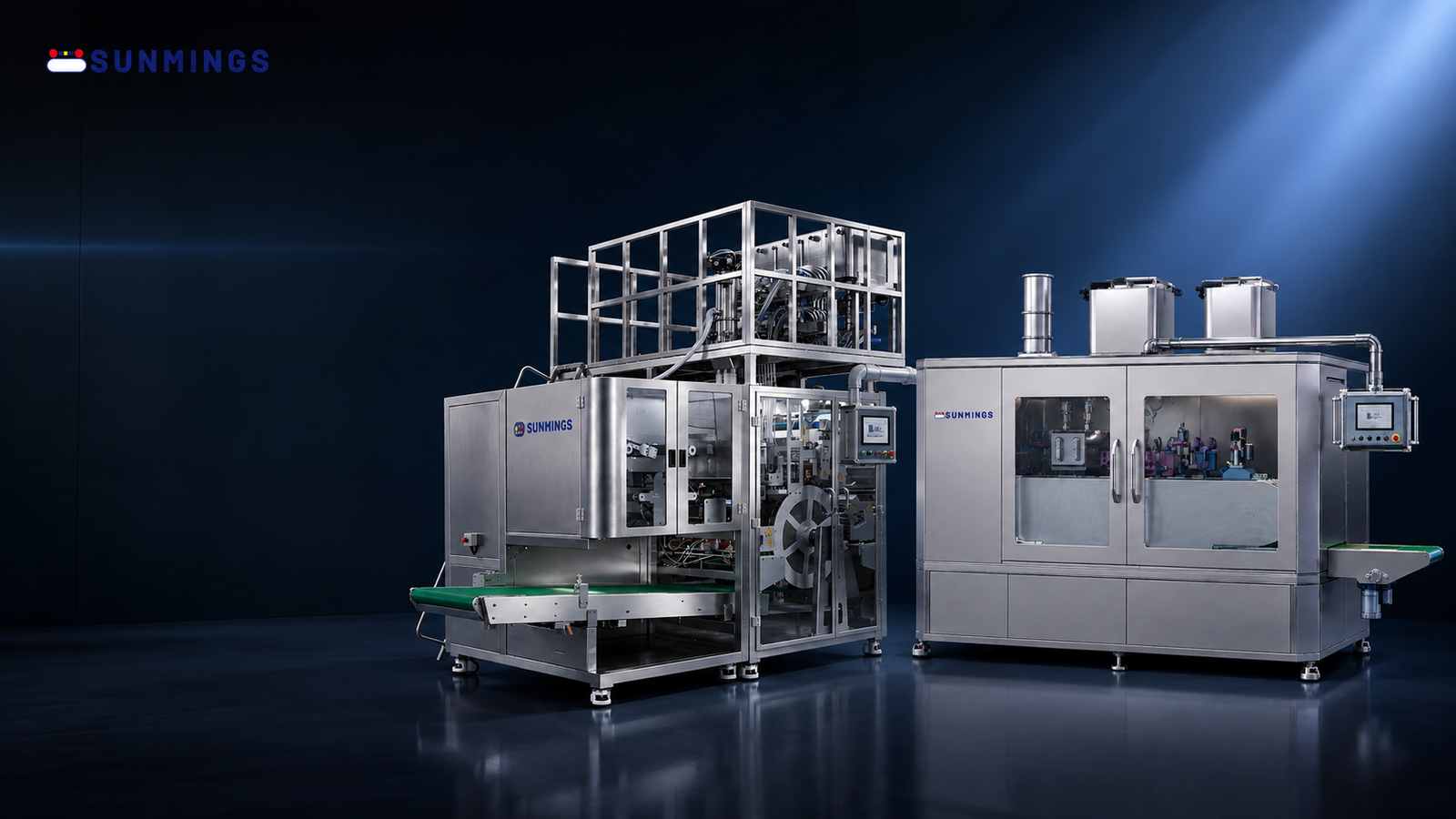
At a basic level, a laundry pod manufacturing machine completes one core task: it transforms water-soluble film and liquid formulation into a sealed single-dose product that can be released directly onto a conveyor for downstream handling. Behind this simple result, however, are several highly important process stages.
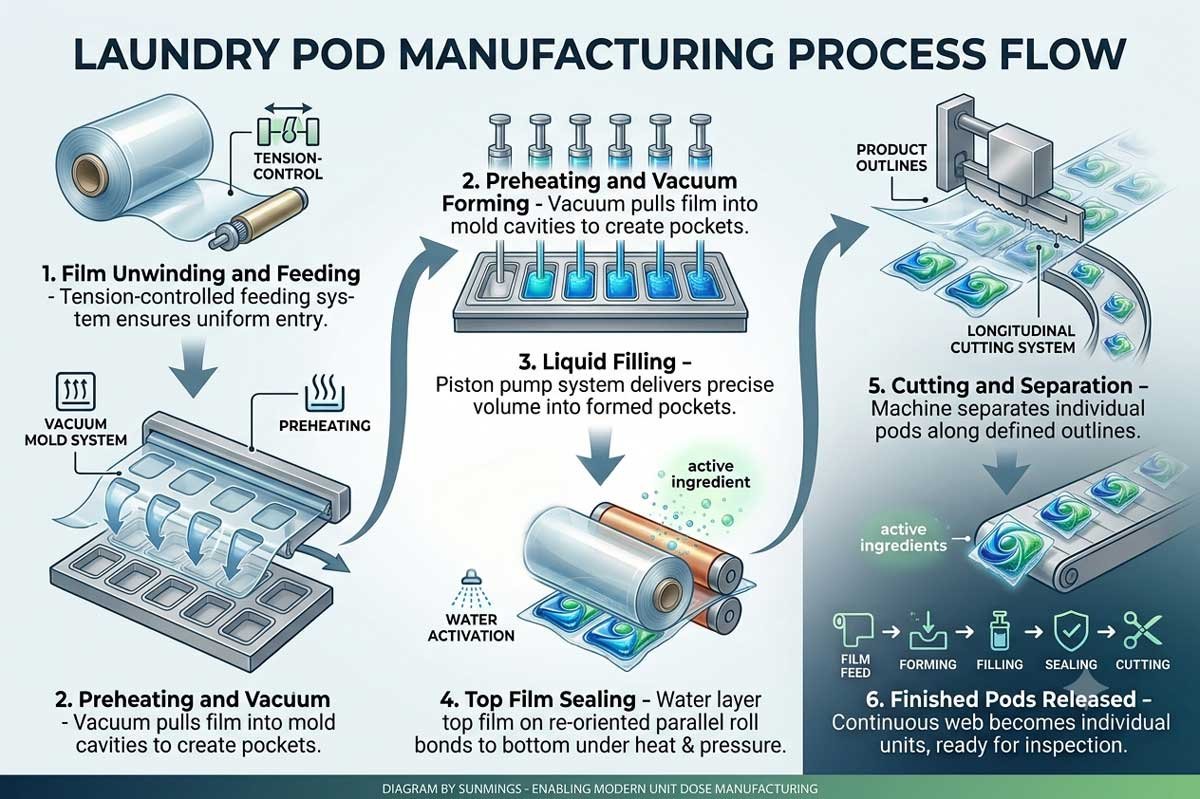
1. Film Unwinding and Feeding
The process begins with the water-soluble film roll. The film is unwound from the roll and fed smoothly into the mold system through a tension-controlled feeding mechanism.
This step is more important than it may seem. Water-soluble film is sensitive to tension, stretching and environmental conditions. If the film is fed unevenly, it may wrinkle, shift or lose dimensional stability, which will directly affect the forming and sealing quality. A stable unwinding system ensures that the film enters the machine in a controlled and repeatable way, creating the foundation for the next steps.
2. Preheating and Vacuum Forming
Once the bottom film reaches the mold area, it is preconditioned and then drawn into the mold cavities by vacuum.
In this stage, the machine applies vacuum beneath the film so that the film is pulled down and closely attached to the mold cavity. This creates a series of open pockets that can later be filled with liquid. In practical production, this step is critical because the shape, depth and consistency of these cavities determine whether the product can be filled accurately and sealed properly.
In other words, this is the point where a flat film becomes a functional product structure.
3. Liquid Filling
After the cavities are formed, the machine moves to the filling stage. Liquid formulation is dosed into each cavity through a piston pump filling system.
The role of the filling system is to deliver the correct amount of product into each formed pocket at high speed and with high consistency. If the dosing volume is unstable, the final pods may vary in weight, performance and sealing quality. This is why the filling stage is one of the core technologies of a laundry pod machine.
A good filling system must balance accuracy, speed and long-term reliability. In large-scale production, even small variations in filling accuracy can lead to significant product quality issues.
4. Top Film Sealing
Once filling is completed, the top film is introduced to close the product. Before sealing, a thin layer of water is applied to the surface of the upper film. This helps activate the water-soluble film surface and prepares it for bonding.
The upper film is then brought together with the bottom film, and both layers pass through heated lamination or sealing rollers. Under controlled temperature and pressure, the two film layers bond together to form a sealed pod.
This step determines the integrity of the final product. A proper seal must be strong enough to survive handling, packaging and transportation, while still dissolving correctly during consumer use. For this reason, sealing is not simply a closing action — it is one of the most important quality control points in the entire manufacturing process.
5. Cutting and Separation
After sealing, the continuous web of connected pods moves to the cutting stage. Here, the machine separates the sealed sheet into individual pods by cutting along the designed product outline.
At this point, the connected structure becomes a series of independent finished products. The cutting system must maintain clean and consistent separation without damaging the sealed edges or deforming the pod shape.
Once cutting is complete, the finished pods are released from the machine onto a conveyor belt for transfer to the next stage, such as inspection, collection or packaging.
6. The Process in Summary
Although the full machine may look complex, the basic production logic can be understood as a clear sequence:
Film feeding → cavity forming → liquid filling → top film sealing → cutting → pod release
Each of these steps depends on the stability of the previous one. If film feeding is unstable, forming becomes inconsistent. If forming is inconsistent, filling accuracy suffers. If filling is unstable, sealing quality is affected. That is why pod manufacturing is not just about one isolated technology, but about the coordination of the whole process.
Why This Matters
The performance of a laundry pod does not only depend on the formulation inside. It also depends on how precisely the product is formed, filled and sealed.
A well-designed machine ensures that every pod has consistent shape, fill volume and seal strength. This consistency is essential not only for product appearance, but also for consumer experience, dissolution behavior and cleaning performance.
As the unit dose market continues to evolve, manufacturing technology will play an even more important role. Whether producing standard liquid pods or more advanced multi-component products, the basic principles of film handling, forming, filling and sealing remain at the heart of the process.
Conclusion
Laundry pod manufacturing machines are built around a straightforward but highly controlled process. They begin with a roll of water-soluble film and end with individual sealed pods ready for use. The key stages — film feeding, vacuum forming, liquid filling, top film sealing and cutting — work together to transform materials into a reliable unit dose product.
At Sunmings, we see these process steps not just as machine functions, but as the foundation of modern unit dose manufacturing. Understanding how they work is the first step toward understanding how better products are made.